The upcoming North American World Cup Match is the first ever hosted by three nations: Canada, the United States, and Mexico. Forty-eight (up from thirty-two) teams will compete. At Gifting Sense, FIFA' 26 is more than a once-in-a-generation showcase; it's an opportunity to help children score financial wisdom that will last a lifetime. Here are seven ways any parent or teacher can use #FIFAFever to teach young people smart saving, spending, and goal-setting habits.
One: Have the "Big Purchase" Conversation. 🫰🏼
A World Cup match is a dream purchase for most kids and their families. It involves travel and all sorts of other costs, in addition to once-in-a-lifetime experiences. Instead of letting those costs remain “adult business,” let’s invite kids into the conversation as a way to help them develop life-long financial decision-making skills. For example, consider asking them:
- What parts of a FIFA World Cup Match matter most to you? The stadium you’re in, where you sit, or who you see play?
- How can someone determine how much money is required to attend a match?
- How does one compare the all-in cost of one match to another?
These simple questions introduce the idea that money choices involve trade-offs—and kids can grasp this more easily when the stakes feel exciting and personal.
Two: Research what's involved in attending a match. 🎟️
When kids have a clear, exciting goal like tickets to a coveted pro sports event (or a performing artist concert), planning for the event becomes much more interesting. But ticket prices can vary widely depending on the match and/ or location, as can the related expenses like travel, meals, and souvenirs.
This is where a mindful spending tool like the DIMS- DOES IT MAKE SENSE?® SCORE Calculator can be super helpful. The calculator helps young people pause, gather information, and reflect upon a possible purchase, before a family decides whether or not it makes sense for them at a moment in time.
If a young person dreams of attending a FIFA match, but knows it's unrealistic for the whole family to attend, with their parents' blessing, they can use the resultant DIMS SCORE® Report to crowd-fund FIFA Tickets for an upcoming holiday or birthday gift amongst extended family members. What Grandparent wouldn't rather contribute towards this once-in-a-lifetime experience, versus buy clothes that may never be worn, or books that may never be read…
Three: Pay attention to dynamic pricing. ↕️
Dynamic pricing refers to a system where ticket prices can move up and down based on demand, availability, and other factors. For example, if a match is between two smaller teams and the stadium still has lots of seats, those seats might be less expensive. If the game is a semifinal or the final, where everyone wants to go, those seats could be much more costly.
FIFA is committed to dynamic pricing to ensure stadiums are full for every 2026 World Cup match; this could give families a shot at affordable seats if they buy early or target less in-demand matches at the largest stadiums, but it also risks pricing them out of marquee games as demand is likely to drive costs sharply higher.
Four: Budget for the whole FIFA experience. ✈️ 🚄
Let's not forget that tickets can be just the start. Not everyone is going to live within a day-trip distance of a World Cup Stadium. Some families will also need to budget for long-distance travel, accommodation, and meals, not just snacks and souvenirs. Using the DIMS SCORE® TRIPS Calculator, parents can involve kids in anticipating these costs and prioritizing expenses.
This teaches kids:
- How to distinguish needs from wants.
- Comparing prices is crucial for finding deals.
- How to plan for unexpected costs.
- With enough time, planned spending can make dreams come true!
Five: Use a goal-tracker to help save for a purchase that's months away. 🌡️
Saving isn't always easy, especially when the reward is months away. A goal tracker turns the sometimes daunting task of saving into a satisfying journey, keeping kids engaged and motivated by allowing them to:
- Visualize their savings progress.
- More easily avoid impulse purchases that can crowd out savings.
- Experience the joy of watching their efforts add up.
- Build patience by "earning" their goal step by step.
It's not unusual for a single knock-out match ticket to cost upwards of $800. If parents have decided to split the cost of these pricier tickets with their children (agreeing to cover transportation, accommodations, snacks, and maybe souvenirs) and a son or daughter has already saved $80.00 of the $400.00 they need (to split the cost), they'd fill out our Worth-the-Wait Goal Tracker as illustrated.
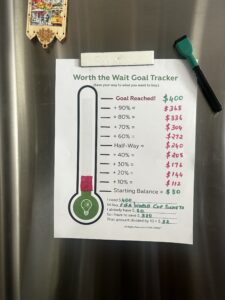
Every time they've saved an additional $32.00, they can move up the "goal-o-meter", one step closer to their dream purchase.
Six: Make saving for tickets, a classroom, or a family affair. 🎞️
Saving for FIFA tickets can even be a bonding experience. Classrooms or families can:
- Set challenges like "no-spend" days, where everyone's lunch is from the "Brown-bag Café" or eaten at home, instead of at a restaurant.
- Celebrate milestones with small rewards. Consider watching a movie about a World Cup Champion like Pelé, Messi, or Beckham once you're halfway towards achieving your FIFA '26 dreams - or the docuseries Welcome to Wrexham, to underscore how hard it is to reach the pinnacle of any sport.
Seven: Exercise the patience muscle. ⏰
Of course, the most fantastic money lesson kids learn through saving for FIFA tickets is patience.
The exercise of calculating the DIMS SCORE® for a dream purchase, filling out the goal tracker, displaying it publicly, and committing to achieving the goal shows children exactly how delayed gratification leads to bigger wins—something World Cup athletes themselves know well!
Give a Legacy of Smart Choices. 🏆
We hope this article explains how planning to attend World Cup ’26 can give young people more than just memories. It can show them that big dreams — whether it’s cheering on their heroes from the stands, saving for their first car, or planning a future adventure — can be reached with thoughtful choices and patience.
The first match kicks off in 38 weeks, but the chance to turn FIFA ’26 into lifelong financial wisdom for our kids is a gift we can begin giving today! 📆
To learn more about our permissionless tools, click on the pink or blue buttons below.
Child Development Financial Literacy For Parents For Teachers