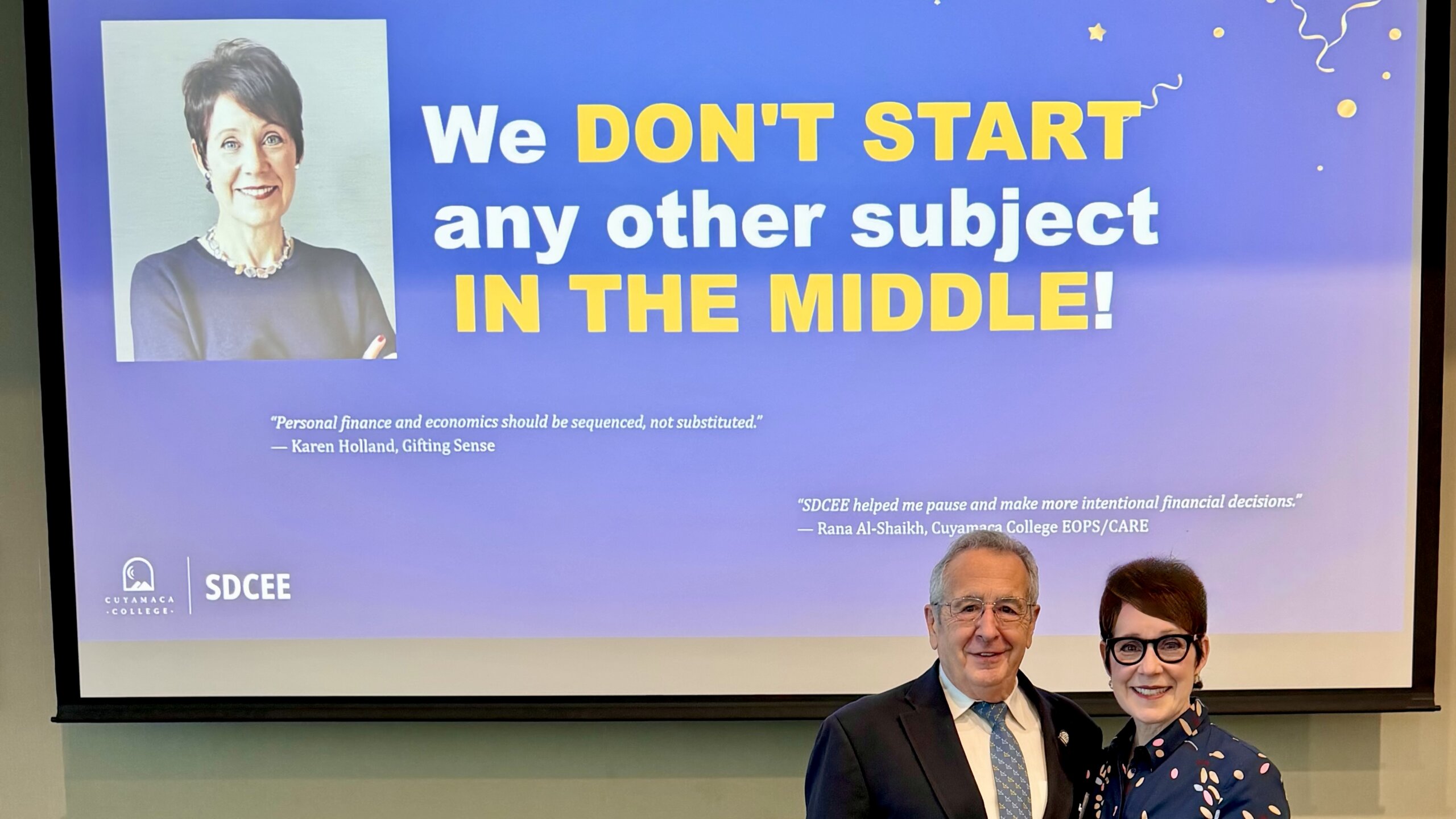
Our founder was invited to deliver the keynote at the 20th-anniversary celebration of the San Diego Center for Economic Education. What follows are her remarks, lightly adapted for reading. With deep gratitude to Professor Emeritus Anthony Zambelli and the entire SDCEE team for their decades of work to ensure young people know that being good with money is within their reach.
Thank you, Tony. And thank you all for being here to celebrate two decades of empowering students, educators, and communities.
Let's Begin with an Observation Worth Pausing On
In most subjects, we build from the very beginning. Reading starts with the alphabet, not Shakespeare. Math starts with counting, not calculus. Science starts with curiosity, not chemistry. We build the foundation first because we know that beyond-basic content without preparation won’t stick.
Personal finance is still building that consistent early foundation.
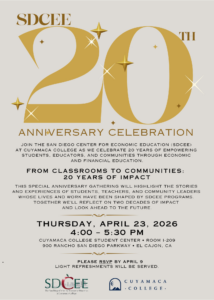 Twenty years ago, the San Diego Center for Economic Education made a bet that economics and personal finance — together — could change young people’s lives. The evidence says you were right. The work happening in financial education classrooms today is truly exciting: excellent content, rigorous curricula, skilled teachers (many of them in this room), and real momentum driven and supported by organizations just like SDCEE.
Let’s explore how we make sure that work lands even more powerfully — by asking a question I’d pose to any room of educators: Have you ever taught something clearly and known, even as you were teaching it, that it wasn’t quite landing? Could that be a timing issue we can solve by design? It might be.
The Preparation Question
Research suggests that money habits and beliefs begin to form as early as age seven. That means by the time a student sits down in a high school personal finance or economics class, they’ve already been making financial decisions for years — sometimes almost a decade — often on instinct, and without formal instruction.
That’s not anyone’s fault. It’s simply the order in which life introduces money. Most of us get at least a little bit to spend — even if it’s just for lunch or school supplies — long before we find ourselves in a personal finance classroom.
Still, that order creates a gap: between when students start making financial decisions, and when we formally begin teaching them how to think about those decisions.
Young people arrive in high school already grounded in math, science, and language arts. What if personal finance made that list?
What Middle School Has That High School Doesn't
Three things are happening in middle school that make it fertile soil for early financial learning.
Students are beginning to earn and spend. They have allowance, birthday money, and small jobs, like babysitting. Money is no longer abstract — it’s in their pocket, sometimes on a device — and they want to use it. That’s a teaching opportunity we don’t have to manufacture.
Middle schoolers are still forming habits and identities. The behaviors introduced between the ages of 9 and 14 aren’t fighting years of momentum — they become the momentum. They get baked in, rather than bolted on later, “aftermarket.”
The gender gap isn't yet measurable.
Research suggests the gender gap in financial literacy is measurable by age 151. In my own work with young people, I haven’t seen it evident in early adolescence, which suggests middle school may be one of the few remaining windows in which a single well-timed intervention can reach every student equally.
Driver's Ed - But For Spending
What could that intervention look like? It could look like Driver’s Ed — but for spending. The same foundational skills and awareness that Driver’s Ed provides to new drivers, but for new, inexperienced young consumers.
We don’t hand teenagers car keys and hope for the best. We give them structured practice in lower-stakes situations, before the consequences get serious. Why not do the same with money?
Just like Driver’s Ed, Spending Ed isn’t the destination — it’s the trip preparation that helps the future unfold the way we want it to.
The habit of asking basic questions about typical purchases before spending isn’t complicated or overly technical, though it does an important job: it allows young people to experience firsthand that anyone can gather and use financial information to make better decisions — in real time, when the consequences of a misstep aren’t catastrophic.
This is not an abstract claim. This is what happens when a child who has never had a conversation about money at home is introduced to mindful spending and discovers that the information they need is available, that the questions are ones they can ask, and that the answers are within their reach.
Real-life Experience is the Key
The heart of mindful spending is not a simulation. It’s a question most young people have occasion to ask: "Should I buy this thing, this item, these jeans, these running shoes, these concert tickets?"
When we give youth a structured, repeatable, quick but not arbitrary way to answer that question well, we’re preparing them for the more sophisticated trade-offs that lie ahead:
- Will I actually use this as much as I think I will?
- Do I know what this truly costs — all in?
- Am I just excited right now, or will I still want this next week?
- Have I actually thought this through, or did I just click “buy”?
Educators will recognize these as the early versions of concepts they already teach: opportunity cost, true cost, delayed gratification, and decision architecture.
The student who has been practicing these questions since middle school already knows opportunity cost. She doesn’t have the vocabulary for it yet — the high school classroom will give her that. And it will stick, because it’s describing something she’s already lived through.
That is a much more powerful starting point than hearing about these ideas for the very first time in high school.
Sequenced, Not Substituted
There’s a very natural path forward — one where basic personal finance and economics are sequenced rather than substituted, so that mastering the former creates genuine curiosity about the latter.
The student who learns to pause before she spends almost can’t help but start asking why prices rise and fall, or why some families have more choices than others. Her confidence and curiosity begin to feed each other, to the point where she naturally seeks out more sophisticated financial information, including economic knowledge, whether in high school or later.
What the Research Says
This is not a lone observation. The evidence is converging from several directions at once.
Research consistently suggests money habits form early2. A 2013 University of Cambridge study found that the habits of mind which shape financial decisions — including planning ahead and delaying gratification — are largely formed in early childhood. So by high school, we’re not introducing a new subject; we’re building on a relationship with money that’s already years in the making. That’s a much harder pedagogical task — and one we can meaningfully ease, if we begin earlier.
Research on decision architecture shows that knowledge alone is insufficient. What people do in the moment depends not just on what they know, but on the habits they’ve practiced.
The good habits piece has had less room to develop than the knowledge piece.
None of this is a curriculum failure. It’s a sequencing opportunity.
What I've Seen in Workshops
My own experience supports the research. In over a decade of delivering Mindful Spending workshops to students aged 9 to 18, I’ve seen one pattern emerge consistently: when students are asked, perhaps for the first time, to pause before a purchase they actually care about by answering simple, structured questions, something shifts. Not just what they decide — but how they decide, and how they approach future financial decisions.
After mindful spending workshops, students are far more likely to pause, gather information, reflect, and — more often than you might expect — choose not to spend. Not because someone told them “no,” but because they now realize they have choices, agency, and the ability to preserve future purchasing power.
This is how practical, early financial education can transform future classrooms into confirmation labs — where what you teach lands immediately, because students already know it’s true.
The Friction Problem
Today’s frictionless spending environment makes this sequencing more urgent, not less.
Buy Now Pay Later alone encourages the very habits we’re trying to build against: underestimating true cost, mistaking short-term excitement for lasting value, and the absence of friction. Friction isn’t all bad — it creates resilience.
Yet today’s financial environment has been engineered to eliminate almost all the helpful friction we grew up with. Algorithmic persuasion is embedded in every platform that teenagers and young adults — not to mention the rest of us — use daily. These are not neutral, benign tools. They were designed to maximize engagement and accelerate commitment.
A student who arrives in this environment without a practiced habit of reflection is navigating a much tougher landscape.
The question isn’t whether we need to build the habit of pausing, gathering information, and reflecting before deciding. The question is when, and the evidence points clearly to beginning before high school.
The Student You're Preparing For
 The SDCEE has helped build something remarkable over the last 20 years. You’ve created content. You’ve supported educators. You’ve helped shape policy and drive momentum. You’ve done all of this with expertise and passion — and it shows.
Imagine students sitting down in the classrooms you’re preparing for — already curious, already practiced at pausing, already living the idea that every spending decision is a choice between what they’re considering and something that might matter more. Including the future.
These students don’t need to be convinced that personal finance and economics have operational reality in their lives. They have just enough lived experience making trade-offs to recognize that your class is much more than merely a stepping stone to graduation.
What would it take to send you that student?
One Chapter Earlier
It may be as simple as beginning one chapter earlier — when habits form naturally, when the gender gap hasn’t yet opened, when money is new and interesting, and when the questions come easily.
Middle school mindful spending lessons are a small and critical piece of the financial literacy puzzle. They don’t require major structural change. They can fit naturally into what’s already happening in classrooms and beyond. And they work, because students are engaging with decisions that matter to them in real time.
When a student discovers that merely asking about a return policy helps them avoid disappointment, reduce waste, improve family harmony, and even protect the planet — all at once, for free — that realization sticks. And once it sticks, it repeats.
This is how the nine-year-old who learns to pause before spending becomes the nineteen-year-old who approaches their paychecks very thoughtfully. That nineteen-year-old has a far better chance of becoming a young adult who can build the life they want from the start — without first having to unwind earlier missteps and bad habits.
 The ABCs and 123s of becoming good with money — taught early, so that everything that follows has the foundation it deserves.
It’s a deceptively simple idea, and a powerful one.
You’ve spent 20 years helping build what students need to learn. Let’s make sure they’re ready to receive it.
We don’t start other subjects in the middle. And we don’t have to start ours there either.
Thank you. 🙏
1 OECD PISA financial literacy assessments have documented this gap since 2012; see also Preston, A. et al. (2024). "When Does the Gender Gap in Financial Literacy Begin?" Economic Record. Link. For accessible commentary, see Dr. Annamaria Lusardi's published interviews on the topic.
2 Whitebread, D. & Bingham, S. (2013). Habit Formation and Learning in Young Children. University of Cambridge / The Money Advice Service. Read the full report.
To learn more about our permissionless mindful spending tool, the DIMS - DOES IT MAKE SENSE?® Score Calculator, please click on the pink or blue buttons below.
Child Development Financial Literacy For Parents For Teachers