New here? The road you're on has two stops before this one — the Smart Spending Learner's Permit (the pause) and the Defensive Spending License (spotting the tactics built to encourage us to buy). By this point, your young person no longer buys impulsively, and they're beginning to recognize when someone is trying to manipulate their decisions. That's a huge accomplishment. But there's one final step. Avoiding bad spending isn't the same thing as directing money toward a meaningful future. This post is that destination: the full license, where a young person stops reacting to money and starts steering it towards the items and experiences that matter the most to them and their family.
The last restriction comes off
In graduated driver licensing, the full license is the day the limits lift. No supervising adult. No more curfew on when you can drive. Just you, the whole road, and complete responsibility for where you go. The Strategic Spending License is that day. There are no more category windows to stay inside — your young person now directs the whole pool: what comes in, what goes out, what's for fun, and what's for later. With that freedom comes the real lesson of this level (one that took many of us years to learn): Strategic spending means deciding what every dollar is for before you spend it. Even the fun ones. (Especially the fun ones!)
Strategy is just seeing the whole road
A Smart Spending Learner's Permit-holder asks, "Should I buy this?" A defensive spender asks, "Am I feeling pressured to buy this?" A strategic spender asks a bigger question: "If I buy this, what else am I saying no to?" Because money is scarce for many, and finite for all. Strategic spenders think about more than just one purchase versus another; they think about their future purchasing power, sometimes far in the future.
Here's the idea that makes it real — and it's mostly arithmetic:
$15 on takeout with friends, once a week, is about $600 over a 40-week school year. Not a tragedy. Friends matter; so does fun. But $600 is also a serious dent in the cost of a new device, a real start on an instrument, or a third of a summer program to earn early college credits. The strategic spender isn't told to skip the takeout. They're shown the whole road — all the possibilities that lie ahead, and then they choose, on purpose.
A few of the ideas that come online at this level:
- Crowding out. Overspend in one lane, and there's nothing left in another. The takeout doesn't feel like a choice against a new phone — until you see that if you keep choosing the takeout, it absolutely is.
- True cost over time. That $9 subscription isn't $9; it's $108 a year, quietly, until somebody cancels it. Pro Tip: History shows we're better at signing up for subscriptions than at canceling ones we're no longer enjoying.
- The sunk-cost trap. "I already spent $40 on this game I don't even like, but maybe I'll buy the $20 expansion, feel better, and get my money's worth." Don't do it; you're just throwing good money after a decision that's already been made and regretted. Learn from disappointing purchases, don't repeat them.
- Allocation. Deciding in advance roughly how much of your budget goes to fun, to saving, and to the goal — so the month has a plan instead of just an ending. Ask your young person: "What's the one thing you're saving for that you'd be genuinely sad to miss? Let's just make sure your everyday spending isn't quietly eating your future ability to get it."
This is when Spending Ed becomes bigger than money. You're no longer teaching your child how to avoid regrettable purchases—you're teaching them to spend in line with their values and make intentional trade-offs in pursuit of the future they want to build. That's a skill they'll use long after they've forgotten what they spent their money on in ninth or tenth grade.
The ritual (Strategic Spending License edition)
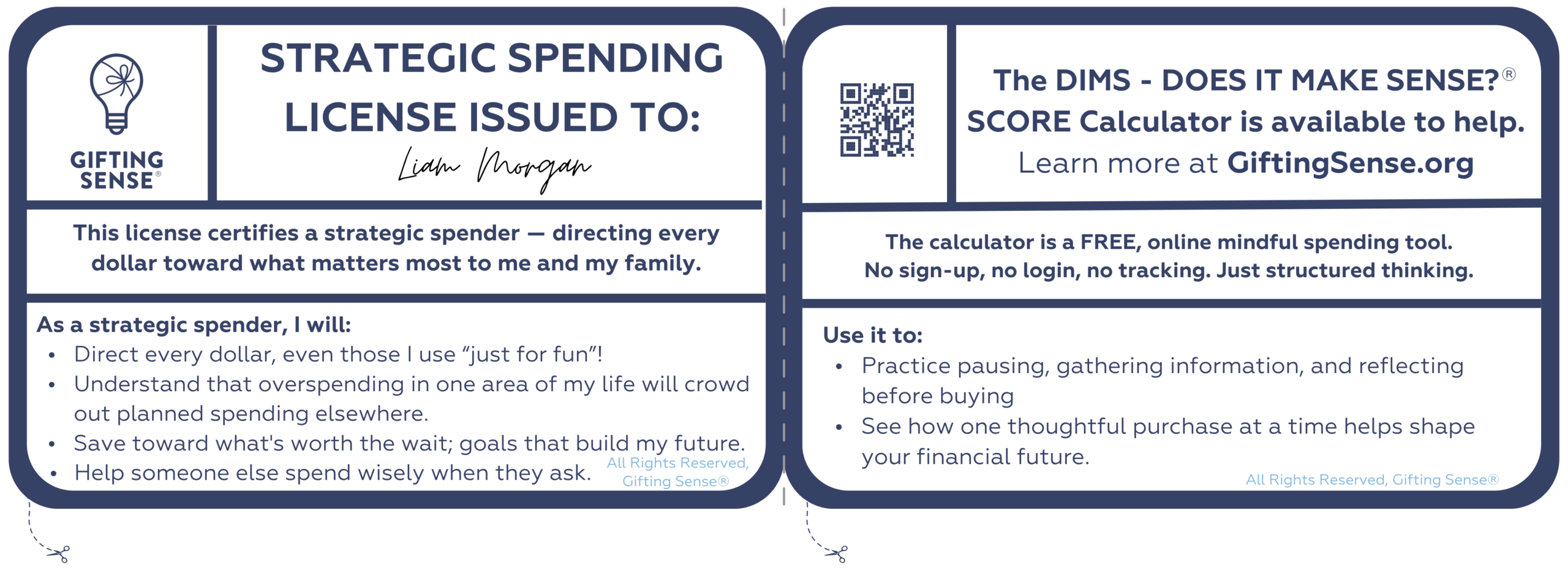
- Have the conversation. "You've practiced the pause and learned to spot the pressure. You're ready to direct your own money toward what matters most to you." This is a big moment for you and your family — treat it like one.
- Take the quiz. The Strategic Spending Quiz also runs slightly longer. And the bar is as high as it gets: 10 out of 10. A full license means knowing every rule of the road cold before you drive solo. Retakes are encouraged; the perfect-score requirement underscores that the independence they’re earning matters.
- Make the Pre-Commitment (more below). Name the goal, map the pressures working against it, and set the guardrails that can protect it.
- Issue the license — and let them sign first. They don’t just add their name; they sign the Strategic Spending License. Hand them the pen. → See the Strategic Spending Licenses here.
The new step: A Pre-Commitment
The permit needed no paperwork. The defensive license added a Family Agreement — something you and your child signed together. The full license adds something different, and the difference is the whole point of this stage. It's a pre-commitment to strategic spending that your young person makes to themselves.
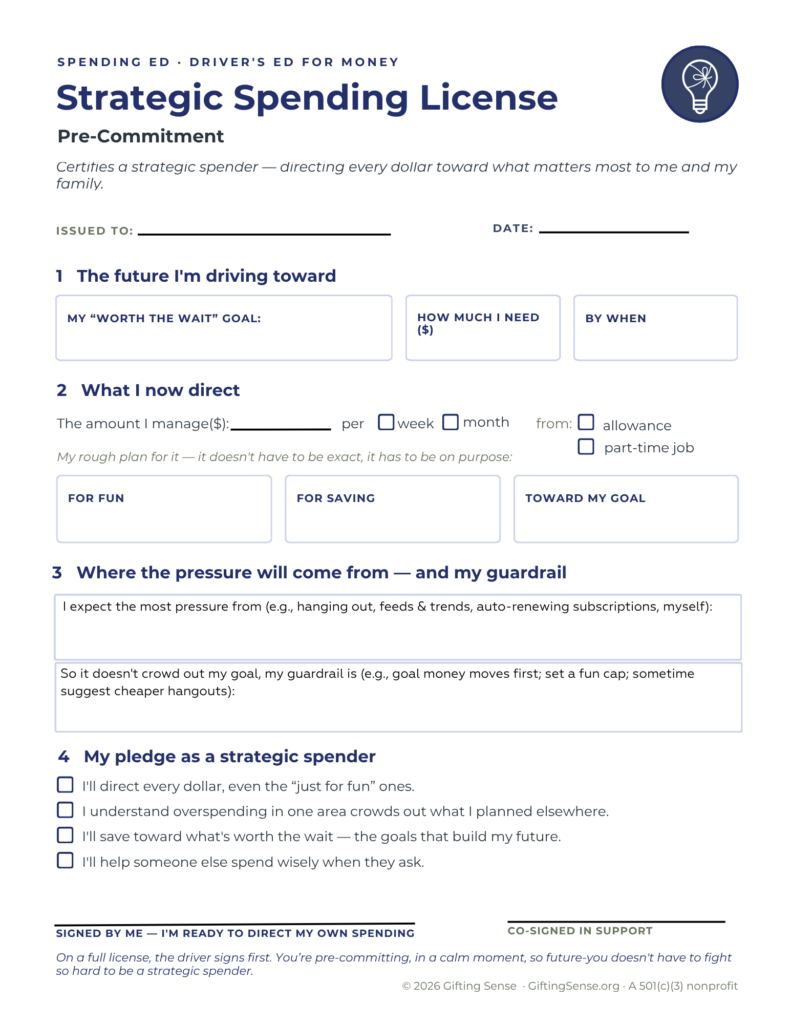
Long before the pressure arrives, they write down three things:
- The goal worth waiting for — the first car, the program, the camera, the trip, the instrument. The future thing they believe will help shape the life they want to build. The goals will change, as life does, but the experience of naming and reaching one could last forever.
- Where the pressure will come from to "spend away" from achieving that goal (they usually already know). Most often it's social: the group that's all going, the thing everyone suddenly has, the feed.
- Their guardrail: the rule they set now, in a calm moment, to protect their goal when the pressure hits later. ("Goal money moves first, before fun." "I'll suggest the cheaper hangout sometimes — and that's okay.") This is an old, powerful trick: you make the wise decision in advance, while you're thinking clearly, so that in the heat of the moment, you're not relying on willpower, which is more aptly named "won't power". A pre-commitment is your kid gently tying themselves to their own future.
Ask your young person: "What guidelines do you want to set for yourself today, so future-you doesn't have to fight so hard to accomplish your goals?"
And because this license is about autonomy, your young person signs it first. (Although you're welcome, in fact encouraged, to co-sign in support!) But on a full license, the driver signs for themselves. That small reversal says everything about where your young person is heading - towards a life where they decide what to spend, when, and where.
One more thing the full license asks: help someone else
There's a line on the Strategic Spending License that isn't on the others: "I'll help someone else spend wisely when they ask." It belongs here, at the top of the road, because the surest sign someone has truly learned something is that they can hand it on. A strategic spender doesn't lecture a friend — they just ask the friend the same questions they ask themselves. "Will you really use it? What else could that money do?" Quietly, your kid becomes the calm voice in someone else's checkout line. Talk about a gift.
The road keeps going
Three graduated licenses. One confident young spender who first learned to PAUSE before making a purchase. Then to PROTECT themselves from the pressure to buy. Finally, to spend with a PLAN. Those are the same three habits many financially confident adults use every day. That's why the combination isn't a small thing to hand a kid before the end of high school. (Years from now, your grown kids might tell you that the habit of mindful spending was one of the best gifts they ever got.)
And the road doesn't end here. The same way spending is the first money skill, it isn't the last — saving and investing are the next stretch of highway. But it all starts with the same quiet superpower your young person has been building since the very first time they asked simple questions about typical purchases before deciding to spend their money or anyone else’s. Hand them the keys. Help them keep their eyes on the road ahead. And then watch them drive. Most of the time, we think you’ll all be pretty happy with the final destination.
To learn more about our permissionless mindful spending tools, click on the pink or blue buttons below.
Child Development Financial Literacy For Kids For Parents For Teachers Spending Ed