We wanted to give parents everything they need to start Spending Ed at home, all in one place, at the start of the summer. This lets you casually incorporate our free tools into your family's summer plans. Grab a coffee. Get ready to make 2026 the year your kids get good with money. We'd love to hear how it's going (karen@giftingsense.org), but otherwise, we'll see you in September.
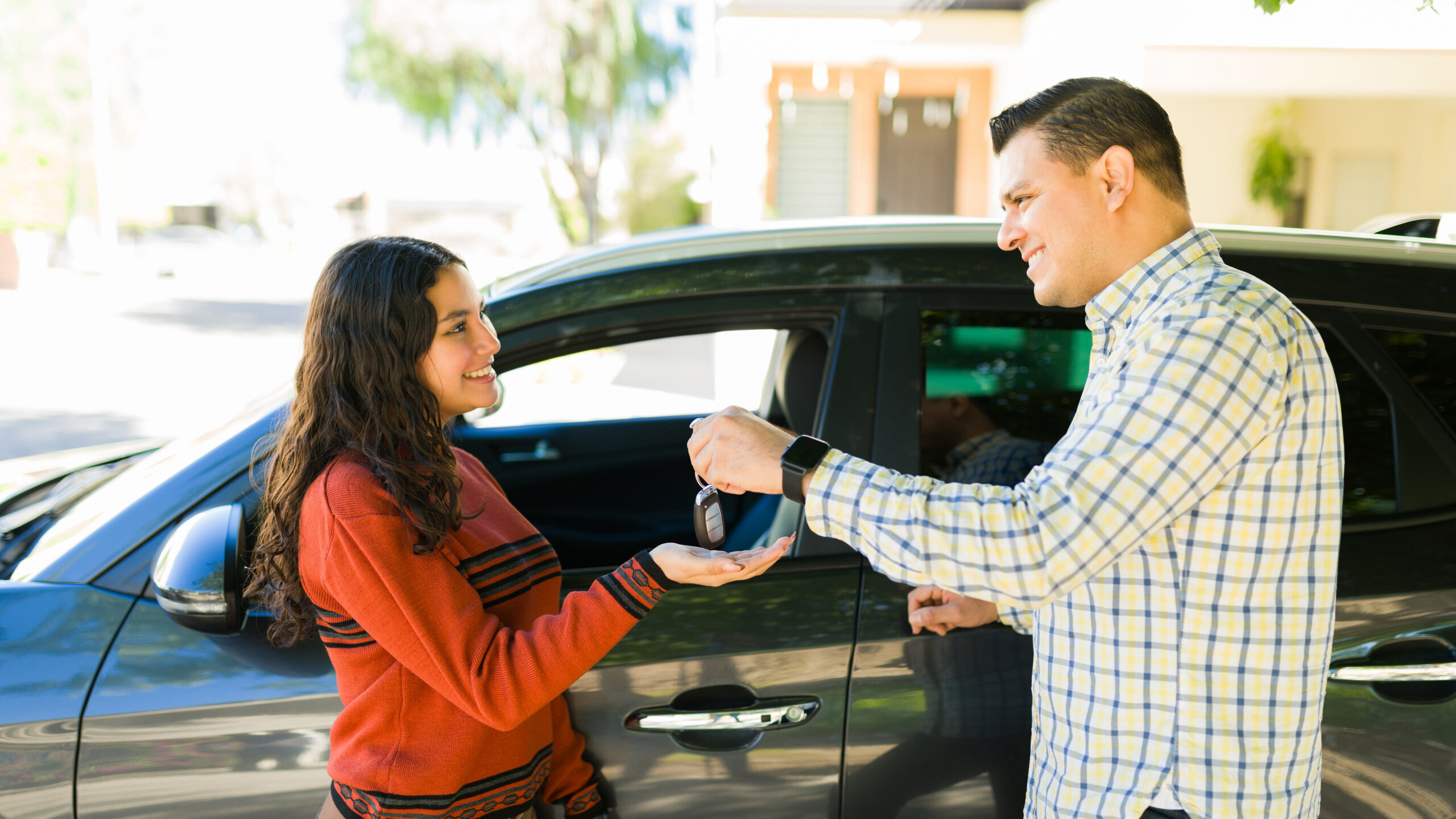
We don't hand teenagers car keys and hope for the best. We give them foundational skills and awareness. We make them earn a learner's permit. We then sit in the passenger seat (quietly holding our breath) while they practice driving in empty parking lots and quiet neighborhoods, long before they get anywhere near a highway. We help our teens build good driving habits in low-stakes situations so that when the stakes are high, those good habits are already in place.
Compare this to how we (unconsciously!) teach kids to spend.
Finger-wagging isn't fun for anyone
Most children start making real spending decisions years before anyone offers them a consistent way to think about it. Allowance, birthday money, vending machines, the school cafeteria, the local toy store… Parents sometimes weigh in, but a structured, repeatable approach to those daily buying moments is often missing. Not because parents don't care about raising money-smart kids (they absolutely do), but because instilling wise spending habits can feel like constant finger-wagging. And that's no fun for anyone.
The result: by the time a teen heads off to high school or college, they've been making financial decisions on instinct for years, sometimes almost a decade. Many parents feel panicky as the next big milestone approaches: leaving middle school, entering high school, or graduating. And with it, the dawning sense that money conversations should have started years ago.
Here's the reframe: that window isn't closing. It's wide open, every single summer, from age 9 until they leave home. Summer, it turns out, is the perfect time to give kids what we've come to call "Spending Ed": structured, age-appropriate practice in making real spending decisions. Driver's Ed, but for money!
What summer has that the school year doesn't
The decisions get visible, and you have time to talk about them. During the school year, money decisions happen alongside (or in spite of) very busy lives. In summer, they move to the center, and you're together long enough to actually engage. A bus ride is the world's most underrated classroom. So is a grocery store. So is the walk home from the library. No homework competing for attention, no school play practice in twenty minutes: just more unstructured time, real choices in front of you (the freezie, the fair wristband, the back-to-school backpack), and a kid who, surprisingly, often wants to talk.
Habits don't fight you yet. Money beliefs begin forming by age seven. Between roughly 9 and 14, they're still soft clay. Behaviors introduced early don't have to overcome years of momentum. They become the momentum. Baked in, not bolted on.
Three on-ramps are already in front of us. You don't need to manufacture Spending Ed moments; they're already on your summer calendar. Each one practices a different muscle: trade-offs, empathy, and dollar-stretching.
1. Making Summer Plans: Whether it's a road trip, a visit to family, a week at day camp, or free afternoons at the splash pad, every summer plan involves trade-offs. Let your kids see the ones you're already making. "We can do the movie or the ice cream, not both this week. Which one are we going to remember?" If there's any money for them to spend on their own (a couple of dollars, $20 from a grandparent), let them. The child who blows it on the first day learns something the child with guardrails never does.
Ask your kids: "Will you actually use this when we get home, or is this more of a 'right now' feeling?" or "What's the one thing you'd be sad you didn't get this summer if you spent your money on something else?" Smart Spending Permit holders (more on this below) will ask these questions before you do!
2. Celebrating Summer Birthdays: Gift-giving is a natural entry point to mindful spending. Selecting gifts turns children into tiny strategists: What does my friend actually like? What will still be used or enjoyed in a month? A small budget makes the lesson sharper, not weaker. It's the moment a kid discovers that thoughtfulness beats price tag almost every time. Bonus: a child who's labored over choosing a gift tends to be a lot more gracious about ones they receive that miss the mark!
Ask your kids: "What would make your friend's face light up when they open it?"
3. Back-to-School Shopping: The August aisles are designed to make us want things. Which makes back-to-school the best possible practice ground for mindful spending. Bring your children in on the actual math: "Here's your budget, here's the school's list, what's your plan?" Let them weigh the cute folder against the plain one and discover how much the difference adds up across nine items. Let them notice that what's on the shelf at eye level is rarely the best deal. Kids who spend their own money learn far more about purchasing power than kids who spend from a parent's wallet.
Ask your kids: "Guess how much we spend every August getting ready for school? This year, you're in charge of helping us spend it wisely." (Put kids squarely in the driver's seat for planning a new school year. → Download our Back-to-School List Builder for free here.)
A three-step ritual to build money-smarts
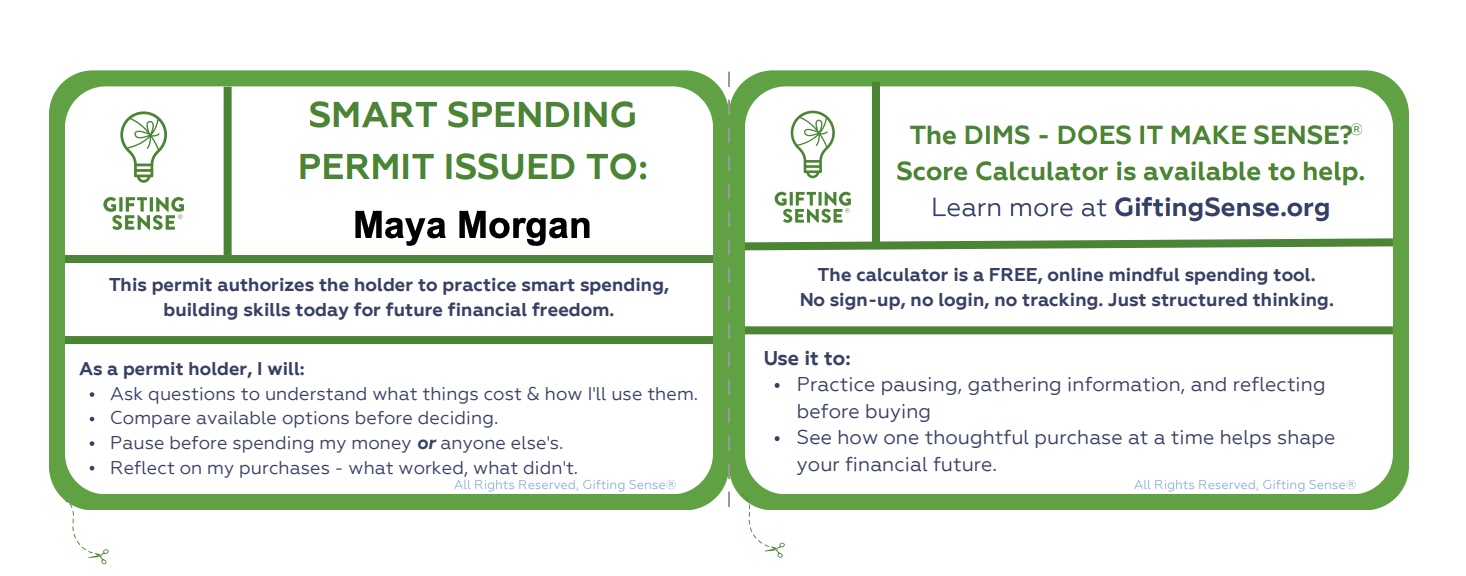
You may have noticed all three on-ramps work best when kids feel like they're in the driver's seat. So before easing into summer's many spending moments, try a ten-minute ritual that hands them the wheel: have your kids earn and receive Smart Spending 'Learner's Permits. We've made this easy to accomplish in three simple steps.
1) Have an upbeat conversation. At dinner, on a walk, or in the car, tell your kids that this summer they're going to start practicing smart spending — the same way teenagers practice driving before they hit the highway. Frame it as a privilege, not a punishment. ("You're old enough now that we want you in the driver's seat for some of these decisions.") Five minutes, tops.
2) Take the quiz. Send your kids to our free Smart Spending Permit On-Ramp. This is a 10-question quiz that takes about five minutes and is designed for ages 9–15. A score of 8/10 or higher earns the permit. Kids who don't pass on the first try can retake it (the conversation that follows is often invaluable). Peek at the answer feedback alongside them — every wrong answer is a teaching moment, and every right answer is a confidence builder.
3) Issue the permit. Once your kids have passed, download a Smart Spending Permit, add their name, and hand it over at the kitchen table the way someone at the DMV would hand over a learner's permit: slight formality, mild ceremony, eye contact. "You're now authorized to practice smart spending. Please practice what you pledge." Most kids love being trusted with grown-up things. The permit is a reminder of what they've committed to and marks the moment the practice begins. That's its job, and it's a big one. → See the free Customizable Smart Spending Permits here.
What if your kid isn't into it?
Some kids light up at being handed grown-up responsibility. Others will roll their eyes or test whether you really mean it. Both are fine — and honestly, the one engaging in "ophthalmic calisthenics" often has the most to gain. You don't need buy-in to start; you need one real decision that they care about in their hands. Let them direct a few actual dollars (a snack budget, a birthday gift, day-trip lunch money) and let the choices do the teaching. A kid who spends "their own money" on something “meh” learns more from that small regret than from any quiz score. Keep it light, keep it real, and let a couple of natural consequences carry the lesson you'd otherwise have to nag about.
Alignment > Restraint
Wise spending isn't about restraint. It's about alignment, avoiding the "meh" purchases that crowd out more meaningful ones. A shared, visible marker of what your family is working toward really helps.
Last summer, a family told us their son thought our Worth the Wait Goal Tracker was "pretty cool", so they put one on the fridge and committed any spare cash toward buying him a new computer. A week later, when the boy asked for pizza for dinner, his mom didn't have to say anything. She just pointed, wordlessly, at the tracker. He understood instantly. No negotiation. No tantrum. No lecture. Two people, same conversation, same song sheet.
You're not teaching your kids to say "no" to everything but the bare necessities. You're teaching them how to say "yes." And not regret it. Our Worth the Wait Goal Tracker keeps families aligned with what they're saving for. → Download the Worth the Wait Goal Tracker for free here.
We're method agnostic, but we built a free tool
If you'd like a little scaffolding for those pause-and-think moments, our DIMS — DOES IT MAKE SENSE?® Score Calculator was purpose-built to help young people discover how easily they can shape their financial future, one thoughtful choice at a time. It's free, on our homepage.
No email, login, or paywall required. Pull it up on any phone, in any checkout line. It walks your kid through the same questions a thoughtful adult would ask before making a purchase, and lets them arrive at a thoughtful answer. → Watch a 90-second demo: running a pair of Air Jordans through the "Does It Make Sense?" Score Calculator.
The nicest part? You don't have to be a finance expert or a nag to do any of this. You just have to be there, which you probably already are.
The mic drop
Tony Steuer has spent nearly 40 years at the intersection of insurance, consumer advocacy, and financial education. He's an award-winning author, host of the Get Ready: Before Life Happens podcast, and the financial readiness advocate behind the Get Ready Movement. So when he says a line lands, we listen — and keep using it. Tony calls our mantra a mic drop: "We don't start any other subject in the middle. Why treat personal finance differently?"
Don't let your kids merge onto the financial highway unprepared
Reading starts with the alphabet, not Shakespeare. Math starts with counting, not calculus. Science starts with curiosity, not chemistry. Let's start personal finance where every other subject begins: at the beginning.
Driver's Ed isn't about raising Formula One drivers. It's about awareness, judgment, confidence, and habits: before life gets faster and more expensive. Spending Ed works the same way; we use the term deliberately because what doesn't have a name doesn't get done.
So this summer, when you've got plans to make, birthdays to figure out, school supplies to buy, and a thousand small decisions in between, treat every one of them as Spending Ed in action: free, low-stakes, perfectly-timed practice in the most underrated subject your kid will ever take.
Roll the windows down. Hand them the metaphorical wheel. Sit in the passenger seat. Point at the goal tracker on the fridge, or their Smart Spending Permit. Not at the price tag.
Once school's out, let Spending Ed in.
Until then, have a great summer with your kids. We'll see you in September.
When your child has practiced the pause for a while (weeks or months, not days), they'll be ready for the next stretch of road: the Defensive Spending License, where they'll learn to spot the ads, apps, aisles, and algorithms designed to rush them into saying "yes."
To learn more about our permissionless mindful spending tools, click on the pink or blue buttons below.
Child Development Financial Literacy For Kids For Parents For Teachers Spending Ed