If you're new here, please ensure you’ve already read about Smart Spending Learner's Permits, which is where we’d prefer every young spender to begin. This post is for the child who's already earned their Smart Spending Learner’s Permit — who's practiced pausing to ask "Should I buy this?" and is ready for the next license on the road to becoming a confident, capable spender. The pause isn't the finish line—it simply creates enough space to notice what's happening around you.
In Driver’s Ed, a learner's permit means an experienced driver is always in the car. Their intermediate license is a genuine leap because it now allows your teen to drive alone. Not everywhere, not at every hour, but on their own, on agreed roads, with a few sensible limits everyone signed off on. The Defensive Spending License is that same leap. Until now, your child has practiced pausing before making a purchase with you riding shotgun. Now they take the wheel on a few real spending categories (clothes, out-of-home snacks, gaming) within the limits you both set in advance (more on that below). When driving alone, it's just as important to watch out for other drivers as to steer.
A quick word before we go further
This isn't a race, and it isn't a checklist to finish by Labor Day. Most families take about a summer per license — the permit one year, defensive the next, strategic when your young person's ready. There's no penalty for going slow, and a lot of quiet value in letting each stage settle before the next. One license, done well, beats three rushed.
Now, let's take a look in the rear-view mirror
To begin, sit down together and ask your child to name two purchases from their Smart Spending "Learner's Permit" season: The best money they ever spent — something they used, loved, and would buy again in a heartbeat. Then the one they'd take back — the buy they regretted, whether the regret hit instantly or a week later. There are no wrong answers, and the regret one isn't a gotcha. Taking a backward glance is one of the ways a good driver gets better; you check your mirrors. The kid who can say "I wish I'd waited on that" has learned something no lecture could teach.
Because these days, the pressure to spend is relentless
Defensive driving involves understanding that other drivers might do something unexpected, and being ready for it. Defensive spending means knowing that almost everything in a young person's path today is engineered to pull a fast "yes" out of them — and being ready for that, too. That's the new muscle the intermediate Defensive Spending License builds, and it's a big one. The pause your child learned as a permit-holder protected them from their own impulses. Defensive spending protects them from everyone else's.
Here's why this matters: children don't become wise spenders simply by getting older—they become wise spenders by getting practice. Every thoughtful spending decision helps them recognize which purchases truly serve them and which don't. A young person who can identify the pressure to buy has a quiet superpower that many parents had to learn the hard way. (In fact, many parents have told us that even they find the tactics below surprisingly persuasive.)
Here are a few of the hazards a defensive spender learns to spot on sight:
- Manufactured scarcity: "Only 2 left!" / "14 people are looking at this." The clock and the crowd are usually invented to rush you past thinking.
- False urgency: Countdown timers and "Today only!" A real deal is still a deal tomorrow.
- Misleading Cost Splitting: Buy Now Pay Later splits $80 into four payments of $20, which makes a purchase feel smaller than it is, so you commit without fully appreciating the total cost.
- One-tap checkout: Built to remove the pause on purpose. The whole point is that you don't stop and think before you buy.
- Nudges: "Free shipping over $50" when your cart says $38. The nudge that gets you to spend $15 more to "save" $7.
- Paid Persuasion: "Link in bio — run, don't walk." Pressure dressed up as a friend's tip.
- Limited-time skins and loot boxes: Many games sell "limited-time" extras — special outfits for a character, or mystery packs where you pay without knowing what's inside. The rush to buy before time runs out is, once again, the whole point.
Ask your child: "What's the trick here — and who's it working for?"
The ritual (Defensive Spending License edition)
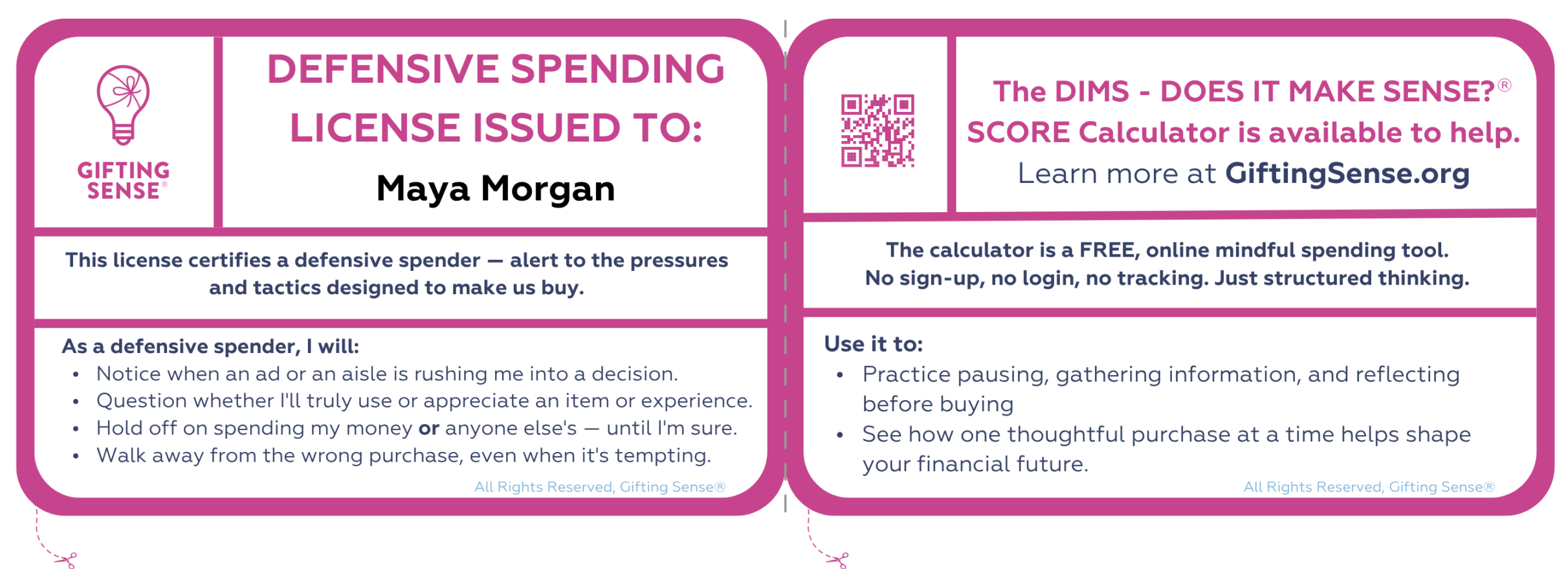
You’ll recognize the short (now a 4-step) process we suggest from the Smart Spending Learner's Permit. At this intermediate level, we’ve added the Family Agreement and raised the bar on the quiz, the way every successive license should.
- Have the conversation. "You've practiced pausing before purchasing. You're ready to drive more of these decisions on your own." Frame it as the promotion it is. And if your child greets the news with a shrug rather than a grin, that's fine — you don't need their complete enthusiasm to begin, placing one or two categories that they really care about (clothes they love, annual outings) usually gets them there.
- Take the quiz. The free Defensive Spending Quiz takes slightly longer and is built for this stage. The bar is a little higher now (we’re asking kids to get 9 out of 10) because spotting pressure tactics is exactly what the license certifies them for. Retakes are encouraged; every miss is a tactic worth talking through, a natural segue to a "smart money talk".
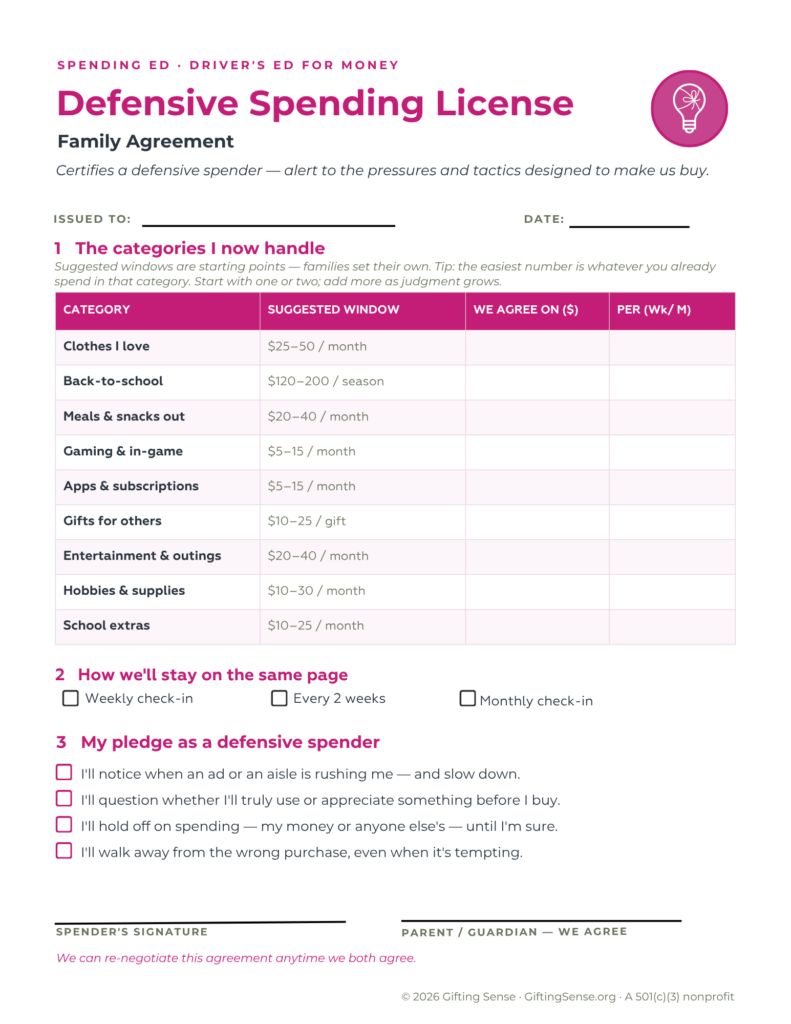
- Fill out the Family Agreement — together. The agreement (more below) is where you formally decide on categories of spending (clothes they love, snacks out with friends, a gaming subscription), dollar-amount limits within those categories, and how often you'll check in. Both of you sign.
- Issue the license. Add their name and hand it over with the same small ceremony as the learner's permit. "You're now cleared to spend defensively, on your own, on what and for how much, we’ve agreed. Please honor the pledge you're making." → See the free Defensive Spending Licenses here.
The new step: a Family Agreement
The Family Agreement is where the greater independence lives.
 A few things make it work well:
- It's the same money, just redirected. The cleanest starting number is whatever your family already spends in that category. You're not adding an allowance; you're handing over responsibility for directing some dollars. Start with one or two categories. We suggest the ones that are frequent skirmishes (like out-of-the-home snacks or in-game purchases), and add more as your young person's judgment grows.
- This is designed to work at any budget. No family should have to spend one dollar more to do this. Where money's tight, the "limit" can simply be a portion of an existing budget that your child now gets to direct ("you'll now choose snacks within our weekly grocery bill").
- It can be reopened anytime you both agree. We're parents too. We know, real life gets in the way all the time. A growth spurt, a new interest, a month where money's tighter. The Family Agreement bends on purpose; that's a feature, not a bug.
Ask your kid: "Which categories do you feel ready to own — and what limit feels fair to both of us?"
What this license really teaches
The Smart Spending Learner's Permit taught your child to pause before making a purchase. The Defensive License teaches them that the pause has opponents - that they can beat every day in any checkout line. That's consumer confidence. A kid who knows the aisle was designed to move them isn't afraid of making a misstep. They just walk it with their eyes open.
And once they've got that down? There's one more license on the road to becoming "good with money," where they stop merely defending their money and start directing it toward the future they want to build. That's the Strategic Spending License. We'll see you there.
In the interim, roll down the windows. Hand your kids the wheel. And maybe employ the same line your parents used when you were a kid: "It's not you I'm worried about, it's the other guy"; in this case, the relentless... pressure... to buy.
To learn more about our permissionless mindful spending tools, click on the pink or blue buttons below.
Child Development Financial Literacy For Kids For Parents For Teachers Spending Ed