
Please note that each of the Smart Spending Learner's Permit, Defensive Spending License, and Strategic Spending License has a supporting post for educators who want more detail about each level of our Pause, Protect, and Plan graduated licensing program.
Driver's Ed Builds Good Habits Before Independence
Long before students take a personal finance or economics course, they're already making financial decisions. Every school day, high school students decide whether to buy lunch, grab a snack on the way home, or order something online. Even most middle-school students are already making purchasing decisions with birthday money, allowance, earnings from a first job, or the balance on a gift card.
Increasingly, those decisions occur in digital environments designed to encourage quick "yeses": one-tap checkout, countdown timers, influencer recommendations, and Buy Now, Pay Later offers.
Imagine if we approached Driver's Ed the same way. Imagine handing teenagers the car keys first, then teaching them how to drive years later. We would never do it. We know that good driving habits are easiest to build before bad ones have set in, and while the stakes are still low. We give new drivers foundational skills and awareness. They earn a learner's permit, practice in low-risk situations, and gradually earn greater independence as they demonstrate good judgment.
Spending Ed Applies that Same Approach to Money
Students arrive in high school already grounded in language arts, mathematics, and science — which is why a teacher can open a novel, a lab, or an algebra unit and build from something. Personal finance is the exception. For many students, their first structured conversation about money arrives after years of making real spending decisions without a framework. Many organizations, including the CFPB and the Council for Economic Education, have emphasized the importance of introducing financial education early and reinforcing it over time; the gap is in practice, not in principle.
Rather than beginning with budgets, investing, or retirement planning, Spending Ed starts where almost every young person already lives: spending the little bit of money that comes their way. We are not claiming to be the complete answer to personal finance education. We are addressing when it is first taught. We believe learning to make thoughtful spending decisions creates a solid foundation for later financial knowledge. It helps students develop the mindset: "I can help shape my own future." Once students discover that they can use financial information to improve decisions they make today, tomorrow's financial tools begin to feel like they belong to them too.
Why Spending Ed Fits So Naturally in Schools
Teachers already spend their days helping students think well. You ask students to evaluate evidence before reaching conclusions, compare alternatives before choosing a solution, and question persuasive messages before accepting an argument. Spending Ed simply brings those same habits into one more part of students' lives: the spending decisions they're already making. That's why Spending Ed doesn't tell students what they should or shouldn't buy. Instead, it teaches them how to think about spending.
That distinction matters. Students rarely remember being told what to think. They remember discovering something for themselves.
Start with the Habit of Thinking Before Buying, Reinforce It Over Time
Ideally, students first participate in a Gifting Sense Mindful Spending Workshop. Through discussion, reflection, and hands-on activities, they discover one deceptively simple habit: thinking before buying. The graduated Smart Spending licenses don't replace that experience. They extend it. Think of the workshop as learning the fundamentals of driving. The licenses provide the structured practice that follows, helping students revisit, strengthen, and eventually internalize those habits until they begin to surface naturally when needed.
Of course, schools don't always have the luxury of delivering everything in the ideal order. That's why each Spending Ed Quick Start Lesson Plan includes enough context to serve as a solid starting point on its own. Whether students begin with a mindful spending workshop or a Quick Start lesson, the destination is the same: becoming thoughtful, confident decision-makers.
Meet the Three Smart Spending Licenses
Just as Driver's Ed introduces responsibility gradually, Spending Ed does, too.
LEVEL ONE: Smart Spending Learner's Permit - PAUSE
The Smart Spending Learner's Permit teaches students to PAUSE. Rather than reacting automatically, they learn to ask one simple question: "Should I buy this?" Students quickly discover that thoughtful spending isn't about saying "no." It's about slowing down long enough for their own good judgment to catch up.
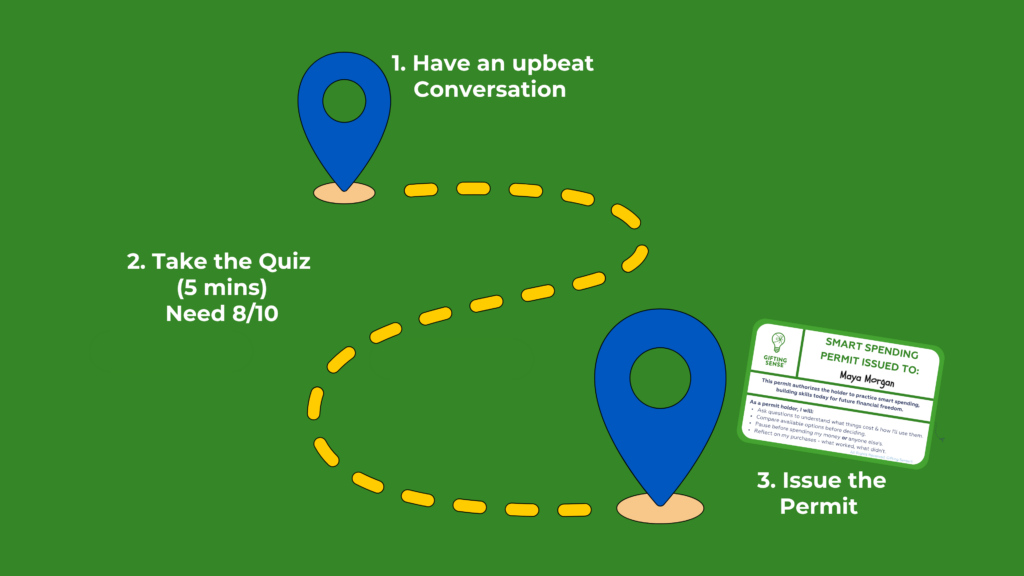
Students can earn their Smart Spending Learner's Permit in three steps: have a conversation with a parent or in class, take a 5-minute Quiz, then produce and personalize their permit.
LEVEL TWO: Defensive Spending License - PROTECT
The Defensive Spending License teaches students to PROTECT their purchasing power. Once they've practiced pausing, they're ready to notice something many adults still struggle to see: modern spending environments are intentionally designed to encourage quick decisions. Here the question becomes: "What's the trick—and who is it working for?" Like defensive drivers, students learn to anticipate pressure before it catches them by surprise.
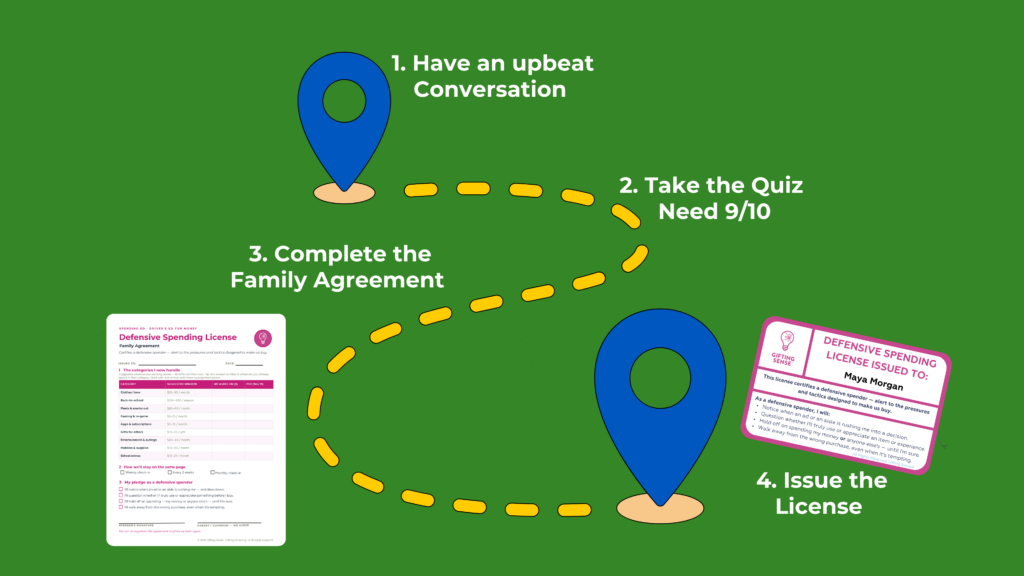
The Family Agreement added at this level is one way for students to formalize categories and limits within which they can practice independent defensive spending. We understand that not every school will feel comfortable assigning the Family Agreement, so a Student Agreement is also available. This ensures that every young person has the opportunity to practice spotting the pressure to spend*. Completing either agreement fully satisfies the requirements for the Defensive Spending License.
Students can earn their Defensive Spending License in four steps: have a conversation with a parent or in class, take a 6-minute Quiz, complete their Family or Student Agreement, then produce and personalize their license.
*Research using national data finds that the majority of U.S. children ages 6–15 receive an allowance, and that this practice is common across income levels rather than limited to higher-income families (Collins & Odders-White, 2021). This, along with our own classroom experience, suggests that opportunities to practice managing small amounts of money exist across a wide range of family circumstances.
LEVEL THREE: Strategic Spending License - PLAN
The Strategic Spending License teaches students to PLAN. The question grows up with them: "If I buy this, what else am I saying no to?" Students begin to experience opportunity cost not as an economic term but as something real in their own lives. Every dollar spent represents another opportunity given up. That's the beginning of strategic spending.
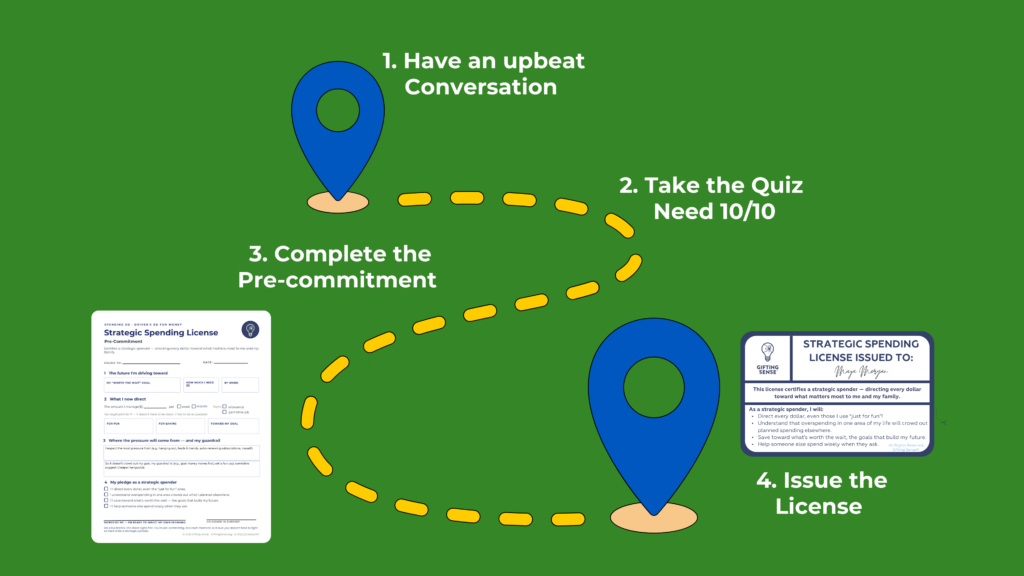
The Strategic License adds a Pre-Commitment that invites students to identify a meaningful future goal, anticipate the pressures that might derail it, and create their own guardrails before temptation arises.
Students can earn their Strategic Spending License in four steps: have a conversation with a parent or in class, take a 7-minute Quiz, complete their Pre-Commitment, then produce and personalize their license.
Recommended Progression by Grade
Could students earn all three licenses in one semester? Certainly. Would we recommend it? Probably not. Just as Driver's Ed spreads learning over time, Spending Ed works best when each habit has time to become part of a student's everyday thinking before adding another layer.
Our suggested progression looks something like this:
- Grades 5–9: Smart Spending Learner's Permit
- Grades 6–10: Defensive Spending License
- Grades 7–11: Strategic Spending License
Schools should adapt the program to fit their own students and curriculum. There is no penalty for starting later or moving more quickly. But if you have the opportunity, we'd encourage you to let each stage breathe. One license, done well, beats three rushed.
No Need to Redesign Your Curriculum
For more than a decade, teachers have successfully used GIFTING SENSE's mindful spending workshops and the DIMS – DOES IT MAKE SENSE?® SCORE Calculator in Financial Literacy Month activities, advisory periods, business and economics classes, media literacy, lunch clubs, summer camps, enrichment days, and independent homework. Spending Ed was intentionally designed to fit into those same settings.
Two 20- to 30-minute classroom sessions are enough to get started. Ideally, the first introduces students to mindful spending through a Gifting Sense Mindful Spending Workshop. The second begins Spending Ed itself, with students earning their Smart Spending Learner's Permit. From there, the Defensive and Strategic levels offer repeated opportunities to practice, spread over months or years as it suits your students. If your class hasn't attended a workshop, the Quick Start Lesson Plans include everything you need to begin. Our mindful spending tool, the DIMS SCORE® Calculator, is designed to be intuitive enough for older students to use on their own.
Two Simple Ways to Get Started Today
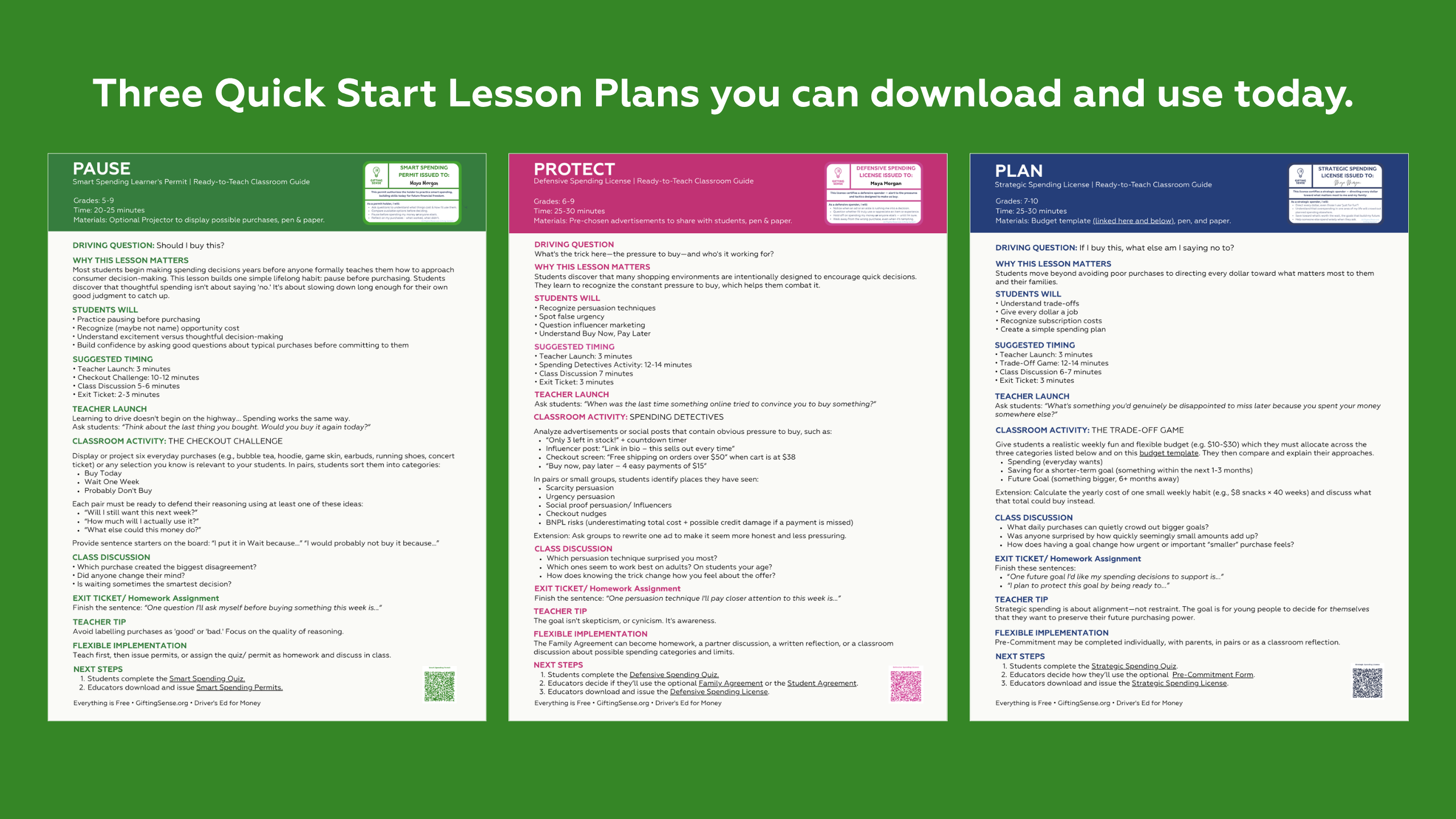
- You can jump right into Spending Ed (download our Quick Start Lesson Plans here), or
- You can give your class a Mindful Spending Workshop first. This is our preference because it allows students time to reflect on their current approach to spending - and embrace more deliberate consumer decision-making - before they earn their first license (the Smart Spending Learner's Permit).
Both approaches work. One simply gives students a little more time to practice the habit of thinking before buying, before earning their permit and licenses.
The Life Skills Students Build Along the Way
At first glance, Spending Ed appears to be only about spending. That's by design, because spending is where almost every young person's financial life begins. But along the way, students are also practicing critical thinking, decision-making, delayed gratification, media literacy, self-regulation, goal setting, communication, and opportunity cost. These are life skills that already appear throughout curriculum mandates. Spending Ed simply gives students (and their teachers) another meaningful place to apply them.
What Spending Ed Does—and Does Not—Cover
Spending Ed intentionally focuses on Spending, with supporting connections to Saving. It does not attempt to teach Earning Income, Investing, or Managing Risk, and it addresses Managing Credit only where topics such as Buy Now, Pay Later directly affect spending decisions. Those subjects belong in the excellent, comprehensive personal finance courses already available in many high schools. Spending Ed has one job: helping students arrive in high school already thinking like thoughtful consumers.
Spending Ed is not a substitute for high school personal finance instruction. It is designed to be the chapter that comes before it. When that chapter comes first, it supports learning outcomes already reflected in two current U.S. national frameworks.
How Spending Ed Aligns with U.S. National Standards
Spending Ed primarily supports Standard 2 - Decision Making, from the National Content Standards in K-12 Economics (Council for Economic Education, 3rd ed., 2025). Students repeatedly compare costs and benefits, evaluate alternatives, and recognize how incentives influence choices.
Spending Ed primarily supports the Spending strand from the National Standards for Personal Financial Education (Council for Economic Education & Jump$tart Coalition, 2021), with secondary connections to Saving.
Appendix A provides a detailed alignment showing how individual Spending Ed activities support specific benchmarks.
Help Us Measure What Students Are Learning: Optional NEFE Evaluations
For more than a decade, GIFTING SENSE has received valuable feedback from educators, parents, and young people who have used our tools and resources. To better understand how well the DIMS SCORE® Calculator and Spending Ed are working today, we have added two new optional evaluations, developed using the National Endowment for Financial Education (NEFE) Financial Education Evaluation Toolkit.
- You or your students can evaluate the DIMS - DOES IT MAKE SENSE?® SCORE Calculator here.
- You or your students can evaluate Spending Ed, our Graduated Smart Spending License Program here.
The evaluations collect no personally identifiable information and do not change the permissionless nature of our free educational resources. Every response merely helps us identify what is working well and where we can improve, so we can keep providing practical, effective early financial education for young people.
Everything is Free and Ready to Use
Every Spending Ed resource is available free of charge, just like everything Gifting Sense creates. There is no login, no registration, and no paywall. Whether you'd like to begin with the Quick Start Lesson Plans or learn more about the philosophy behind Driver's Ed for Money in the Spending Ed Booklet first, everything you need is ready when you are.
The Nature of Prevention
Driver's Ed doesn't exist because teenagers are bad drivers. It exists because they're inexperienced drivers, and practice before independence leads to better outcomes. We'll probably never know how many accidents Driver's Ed has prevented. That's the nature of prevention. When something works, the mistake never happens. We believe money deserves the same approach.
Before we hand young people debit cards, credit cards, subscriptions, online shopping accounts, and complete financial independence, let's give them the opportunity to practice. To pause. To notice pressure. To make thoughtful trade-offs. And to discover, through their own experience, that they are capable of making wise financial decisions.
Reading starts with the alphabet, not Shakespeare. Math starts with counting, not calculus. Science starts with curiosity, not chemistry. Personal finance deserves the same progression. Spending Ed is simply one way to begin at the beginning—one smart spending license at a time.
Because the goal was never just to raise kids who spend less. It's to raise young adults who spend with purpose, confidence, and a plan.
To learn more about our permissionless mindful spending tools, click on the pink or blue buttons below.
Child Development Financial Literacy For Kids For Parents For Teachers Spending Ed